

What if a single missing signature on a deed could cost your family $46,000 and eighteen months of waiting in a Santa Clara County courtroom? It's a heavy burden to realize that a forgotten asset might trigger the exact legal nightmare you tried to avoid. If you've discovered that a loved one's property was never formally titled in their trust, you aren't alone. Fortunately, a Heggstad petition acts as a vital relief valve; it offers a way to honor your family's true intentions without the high costs and delays of a full probate.
I know how overwhelming it feels to manage an estate while facing strict court deadlines and the fear of making a costly mistake. This article will show you how to use a Heggstad petition to transfer titles directly into a trust, potentially saving your family from the $46,000 in statutory fees often seen with a $1 million estate. I'll walk through the current 2026 filing requirements, the specific evidence you need to provide the court, and expert advice for navigating the Santa Clara County legal system with confidence.
Key Takeaways
- Understand how a Heggstad petition acts as a legal relief valve to transfer forgotten assets into a trust without starting a full probate case.
- Identify the specific written evidence, such as a Schedule of Assets, required to prove the trust creator's intent to the court.
- Evaluate your eligibility by comparing your asset's value against the updated 2026 small estate thresholds to ensure you choose the most efficient legal path.
- Learn how to significantly reduce the 9 to 18-month waiting period typically required for probate while protecting your family's inheritance from high statutory fees.
What is a Heggstad Petition and How Does It Fix a 'Forgotten' Asset?
Creating a revocable living trust is a major step toward protecting your family, but the process isn't finished until your assets are actually moved into that trust. This step is called "trust funding." It involves changing the legal title of your property, like a San Jose family home, from your individual name to the name of your trust. If a property is left out by mistake, it remains in the deceased person's name. This oversight typically forces the family into a full probate court process that can last over a year.
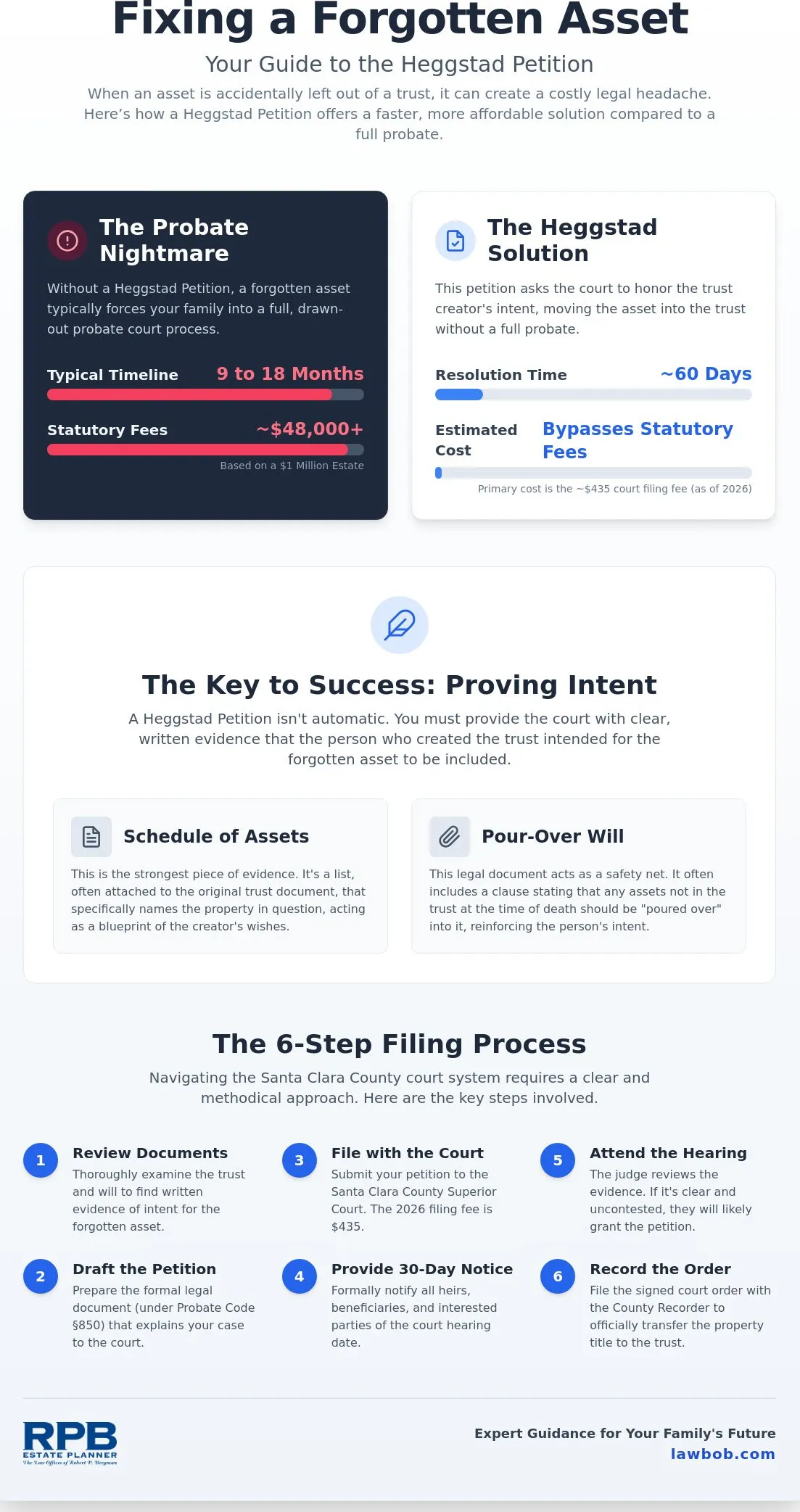
A Heggstad petition acts as a legal request under California Probate Code Section 850. It asks a judge to recognize that an asset belongs in a trust even if the formal title change never happened. While a standard probate case in Santa Clara County often stretches from 9 to 18 months, an uncontested petition can often be resolved in about 60 days. This tool becomes essential for any "forgotten" asset valued above the 2026 small estate threshold of $208,850, as these larger assets would otherwise require full court supervision.
The Cost of a Mistake: Why Avoiding Probate Matters in 2026
The financial impact of a funding error is significant. Under California law, probate fees are calculated based on the gross value of the estate. For a $1 million estate, these statutory fees can climb to over $46,000. These costs come directly out of the inheritance that was meant for your children or beneficiaries. If qualified, by using a Heggstad petition, you can bypass these mandatory fees and move the property into the trust quickly. This approach preserves more of your family's legacy and reduces the time spent dealing with court interference.
The 'Intent' Rule: How the Court Decides to Help You
The court doesn't grant these petitions automatically. You must provide clear proof that the person who created the trust intended for the specific asset to be included. This "second chance" rule comes from the 1993 Estate of Heggstad case. Judges look for written evidence, such as a "Schedule of Assets" attached to the original trust document, that lists the property in question. If you can show this written intent, the court can "transfer" the asset into the trust legally, correcting the titling mistake without a full probate trial.
The Step-by-Step Process of Filing a Heggstad Petition in San Jose
Filing a Heggstad petition in San Jose requires a methodical approach to meet the specific expectations of the local court. It isn't just about filling out forms; it's about telling a clear story of your loved one's intentions. The process begins with a thorough review of the original trust documents to find the specific language that connects the "forgotten" asset to the estate plan. Once you have this evidence, you must draft a formal petition that explains why the court should treat the property as part of the trust.
After drafting, you'll file the paperwork with the Santa Clara County Superior Court. If it is a noticed hearing, California law also requires you to provide a formal 30-day notice of the hearing to all interested parties, including heirs and beneficiaries. This ensures everyone has a chance to see the request before the judge makes a final decision. In many cases, the Heggstad petition can be filed ex parte, which means there is no formal hearing and you can get a decision quickly. If you feel uncertain about these technical steps, consulting with a certified specialist in trust law can help you avoid common filing errors that lead to delays.
Essential Evidence: What You Need to Win Your Case
The "Schedule of Assets" serves as the definitive blueprint for the court to see exactly which properties were meant to be held in the trust. While this list is the primary evidence, "Pour-Over Wills" also act as a critical safety net during this process. These wills often state that any assets left outside the trust should be moved into it upon death, which helps clarify the creator's final wishes. Understanding What is a Heggstad Petition? and how it interacts with these documents is the first step toward a successful court filing.
Navigating the Santa Clara County Probate Court
If there is a court hearing in San Jose, the judge will review your evidence to confirm there is clear written intent and no active disputes among the heirs. If the petition is uncontested and the evidence is solid, the judge will sign a court order. This order is the legal key you need to transfer the title. Once you record this order with the County Recorder, the property is officially part of the trust, and you can manage it without further court interference.
Is a Heggstad Petition Right for Your Family's Situation?
Choosing the right legal path depends on two main factors: the value of the "forgotten" asset and the quality of your evidence. If you've found a property that wasn't properly titled, your first step is checking the math. Silicon Valley real estate values usually mean you're looking at a Heggstad petition rather than simpler options. However, you must have that clear written intent I discussed earlier. Without a list of assets or a specific mention in the trust, the court may not have the legal ground to help you. You can find more details about the legal background of these rulings through the California State Bar on Heggstad Petitions.
It's also vital to consider the family dynamic. My firm focuses exclusively on non-litigated matters. This means I help families who are in agreement and simply need to fix a technical titling mistake. If heirs are fighting over the property or contesting the trust's validity, a different legal approach involving formal litigation would be required. For most families, a professional review of the trust documents is the best way to determine if this "relief valve" is available to you.
Heggstad Petition vs. Small Estate Affidavit
As of July 2026, the threshold for using a small estate affidavit is $208,850. While this is helpful for bank accounts or vehicles, it rarely covers real estate in San Jose. There is a newer simplified process for primary residences valued under $750,000, but many local homes still exceed this limit. When an asset sits above these specific dollar amounts, the Heggstad route becomes the most efficient way to avoid the high costs of a full probate case.
Why a Certified Specialist Makes the Difference
Think of a legal specialist as an architect for your estate. I don't just fill out forms; I build a petition designed to withstand court scrutiny the first time. Practicing San Jose probate law since 1980, I understand the local court's preferences and how to present evidence clearly. This seasoned approach helps you avoid common pitfalls that lead to rejected petitions or unnecessary delays, giving your family the peace of mind that the inheritance is secure.
Secure Your Family's Legacy and Avoid the Probate Nightmare
You've worked hard to build a future for your loved ones, and a simple titling mistake shouldn't be the reason they lose months of time or significant portions of their inheritance to the court system. By utilizing a Heggstad petition, you can honor your original intentions and keep your estate matters private and efficient. Whether you're dealing with a forgotten San Jose home or a mislabeled investment account, the right legal evidence can move these assets back into your trust where they belong.
Robert P. Bergman is a State Bar Certified Specialist in Estate Planning, Trust, and Probate Law Practicing since 1980 and helping families in the San Francisco Bay Area. I offer fixed-cost service models to ensure your legal journey is predictable and transparent. Don't let a "forgotten" asset trigger a full probate trial when a professional, streamlined solution is within reach.
Taking this step today provides the security and peace of mind that comes from being prepared for the unexpected. I'm here to help you navigate the process with a steady hand and seasoned expertise.
Frequently Asked Questions
What is the success rate of a Heggstad Petition in California?
The success rate of a Heggstad petition is generally very high when you can provide clear, written evidence of the trust creator's intent. While official state-wide percentages aren't published, petitions that include a specific "Schedule of Assets" or a "Pour-Over Will" are typically granted by the court without issue. Success depends on the petition being uncontested and properly documented to satisfy the judge's requirements for clear proof.
How much does it cost to file a Heggstad Petition compared to probate?
Filing a Heggstad petition is significantly less expensive than going through the full probate process. For a $1 million estate in California, standard probate fees for the attorney and executor can exceed $46,000. In contrast, the court filing fee in Santa Clara County is only $435 as of January 2026. This allows families to save tens of thousands of dollars that would otherwise be lost to mandatory court costs and statutory fees.
Can I file a Heggstad Petition for a bank account or only real estate?
You can use this legal tool for bank accounts, stocks, business interests, and other personal property, not just real estate. While it's most common for San Jose family homes due to their high value, any asset that was intended for the trust but left in an individual's name is eligible. If the total value of these "forgotten" accounts exceeds the $208,850 small estate threshold, this petition is often the most efficient solution available.
How long does the Heggstad process take in Santa Clara County?
A petition in Santa Clara County is typically resolved in approximately 60 days, while an uncontested ex parte petition might be resolved in 7-10 days. This is a massive time savings compared to a full probate case, which usually takes between 9 and 18 months to complete in the San Jose courts. For a noticed hearing, the 60-day window includes the mandatory 30-day notice period required by California law to ensure all heirs are properly informed before the judge makes a final decision.
What happens if I don't have a written list of assets in my trust?
If you don't have a formal list of assets, you can still succeed by using other documents that show the creator's intent. A "Pour-Over Will" is a common secondary piece of evidence that tells the court all assets should be moved into the trust upon death. However, without any written record of intent, the court may deny the petition. In those cases, the family might be forced to go through the full probate process instead.
Do I need to go to court for a Heggstad Petition hearing?
Most families don't need to physically appear in court for the hearing if they are represented by an attorney. In Santa Clara County, these hearings are often handled by legal counsel, especially when the petition is uncontested. This reduces the stress and emotional burden on the family; it allows your professional team to manage the technical courtroom procedures and judge's questions while you focus on your family's personal needs during a difficult time.