

Why does it feel like your inheritance is stuck in a legal black hole while the months tick by? You aren't alone in feeling frustrated by the silence or the lack of updates from the person in charge. Most people expect the process to be over relatively quickly, only to find themselves wondering exactly how long does the executor have to pay the beneficiaries before the delay becomes a serious legal issue. It's common to feel anxious about whether the money is being managed correctly or if the complexity of Silicon Valley real estate is simply slowing everything down.
This 2026 guide will give you the clarity you need to replace uncertainty with peace of mind. You'll learn the typical California probate timelines, why Santa Clara County court backlogs are currently stretching to 18 months or more, and what you can do to receive your inheritance faster. I will pull back the curtain on what is happening behind the scenes, explain the reality of the "one-year rule," and help you recognize exactly when it is time to seek professional guidance to protect your family legacy.
Key Takeaways
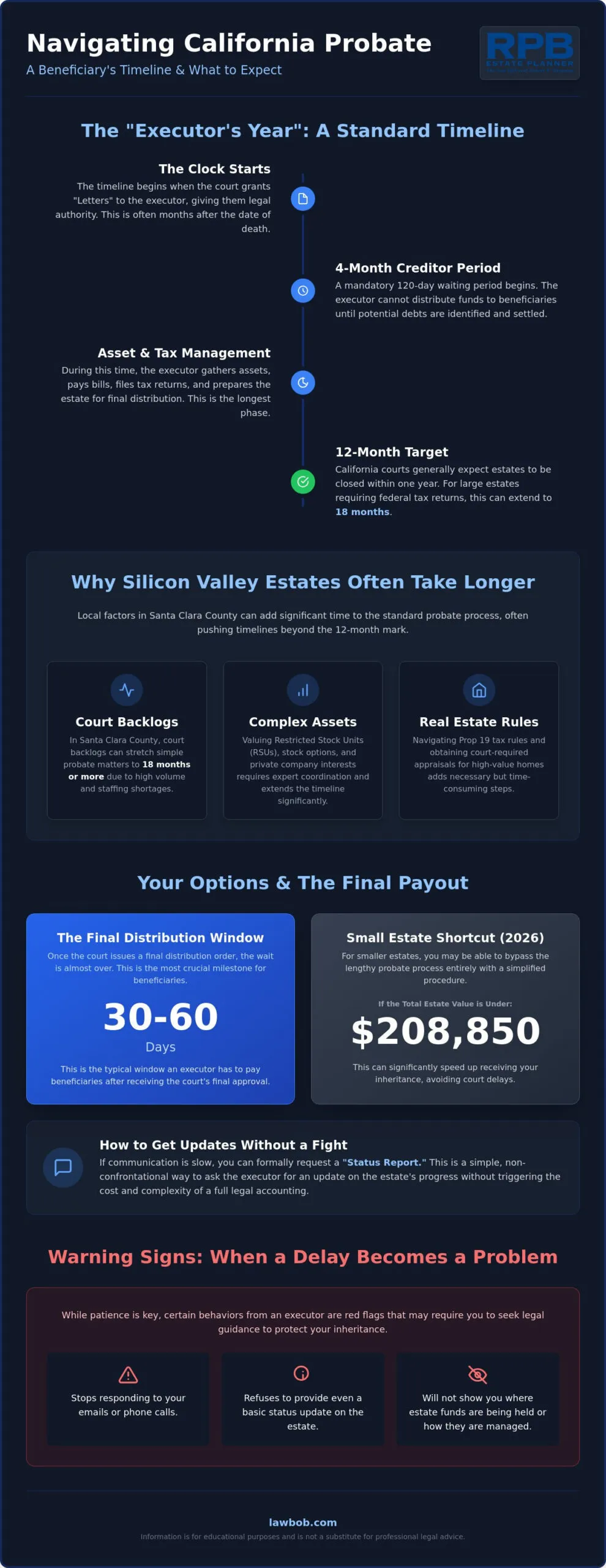
- Understand the "Executor’s Year," which is the standard one-year window the California court provides for handling debts and taxes before final payments are made.
- Discover why Silicon Valley estates often face additional delays due to Santa Clara County court backlogs and the time needed to value complex assets like stock options or business interests.
- Learn exactly when payment must happen once the court issues a final distribution order, which is typically a window of 30 to 60 days.
- Find out how to request a simple "Status Report" to improve communication with an overwhelmed executor without immediately triggering expensive legal accounting fees.
- See if you qualify for a "Small Estate" shortcut that allows you to bypass the traditional probate wait if the estate is valued under the 2026 limit of $208,850.
The "Executor’s Year": Understanding the California Probate Timeline
In California, the legal system generally expects an estate to be wrapped up within 12 months of the executor's appointment. This timeframe is often called the "Executor’s Year," which is the standard window the court provides to handle debts and taxes before final payout. While this sounds like a long time to wait for an inheritance, it's designed to protect everyone involved by ensuring no surprise bills surface after the money is gone. If the estate is particularly large or complex enough to require a federal estate tax return, the court typically extends this expectation to 18 months.
It is helpful to remember that the clock doesn't actually start on the date of death. Instead, the timeline begins only when the court officially grants the executor "Letters," which is the legal document giving them the authority to manage assets. If there are delays in filing the initial petition or if the court is backed up, several months might pass before the executor even has the power to start the process. This is often the first point of confusion when families ask about the payment timeline, as the "year" may not end until long after the first anniversary of a loved one's passing.
The Mandatory Waiting Periods You Can’t Skip
The probate process includes several "blackout dates" where the executor is legally forbidden from distributing assets. The most significant is the four month creditor claim period. Once the executor gives formal notice to potential creditors, they must wait 120 days to see if any valid bills or debts are filed against the estate. Paying beneficiaries before this window closes is risky because the executor must ensure all funeral expenses, final medical bills, and taxes are settled first.
Why "Partial Distributions" Might Be an Option
If the estate has significant cash reserves and the primary debts are already known, the executor can petition the court for a "partial distribution." This allows you to receive a portion of your inheritance early. However, many executors are hesitant to do this. They carry a heavy burden of personal liability; if they distribute funds prematurely and a surprise debt appears later, the executor might have to pay that debt out of their own pocket. Because of this risk, most prefer to wait until the final accounting is approved by a judge before writing any checks.
Why Silicon Valley Estates Often Face Inheritance Delays
Living in Silicon Valley brings unique challenges to the probate process that generic state guides often ignore. While you might be asking about the deadline under California law, the local reality in Santa Clara County is often dictated by a heavily backlogged court system. In 2026, staffing shortages and a high volume of filings mean every petition or hearing can take months longer than the state average. This bottleneck is a primary reason why local probate often stretches beyond the 12 month mark.
Beyond the court's schedule, the nature of local wealth adds layers of complexity. Many estates here include Restricted Stock Units (RSUs), specialized stock options, or interests in private tech companies. These assets require expert valuation and coordination with corporate HR departments, which naturally extends the timeline. Additionally, the "Prop 19" factor complicates matters for family homes. Navigating property tax reassessments for a primary residence is essential to avoid unexpected financial hits for the heirs. Working with an experienced San Jose probate lawyer who understands these local nuances can help prevent simple filing errors that would otherwise reset your waiting period.
Real Estate and the "Market Value" Challenge
Selling a family home in areas like Saratoga or Los Gatos is rarely a quick process. The court requires specific appraisals from a probate referee to establish the fair market value. While this adds weeks to the schedule, it is actually beneficial for you. A proper appraisal establishes a "step-up in basis," which can save you a significant amount in capital gains taxes when the property is eventually sold. Patience during this phase ensures you keep more of your inheritance.
When Delay Becomes "Misconduct"
It's important to distinguish between a "slow court" and an executor who isn't doing their job. If the executor stops answering your emails, refuses to provide a basic status update, or won't show where estate funds are held, these are serious red flags. A diligent executor who is simply stuck in a 12 to 18 month court queue is not the same as one who is ignoring their fiduciary duties. If you suspect mismanagement, you may need to seek professional probate administration support to protect your interests.
How to Speed Up the Process (and Avoid Future Delays)
If you feel stuck in a cycle of waiting, the most effective first step is to open a direct line of communication. Instead of jumping straight to a formal, expensive legal accounting, ask the executor for a simple "Status Report." This is a less aggressive way to get the answers you need and often prompts an overwhelmed executor to provide a clear timeline. While you wait, this report can clarify exactly what tasks remain, such as final tax filings or the completion of asset appraisals.
You should also verify if the estate qualifies for a "Small Estate" shortcut. For 2026, if the total value of the assets is under the $208,850 limit, you might be able to use a simplified affidavit process. This approach bypasses the traditional one-year probate wait entirely, allowing for much faster distribution of funds to heirs. If the estate exceeds this limit, the "Architect" solution for the future is a Revocable Living Trust. A well-funded Living Trust acts as a private blueprint that keeps your family out of the public court system, often allowing for payouts in weeks rather than years.
Your Rights as a Beneficiary
You have a legal right to be kept informed throughout the entire process. The executor holds a "fiduciary duty," which is the highest level of legal responsibility, to act in your best interest and communicate honestly. If you discover that an asset, like a bank account or a piece of real estate, was accidentally left out of a trust, your legal team might be able to use a "Heggstad Petition." This specific court filing can often move that asset into the trust after the fact, potentially saving months of probate time.
The Best Way to Prevent This for Your Own Heirs
Think of your own estate plan as a gift of "time" to your family. When you contrast the 18 month probate delays common in Silicon Valley with the efficiency of a custom-designed estate plan, the value of preparation becomes clear. By setting up your own structures now, you ensure your heirs never have to wonder about the timeline because the path to their inheritance will already be clear and private.
Moving Forward with Clarity and Confidence
Understanding the timeline of an estate helps remove the frustration of the unknown. While the law provides a general framework for the payment timeline, your specific journey depends on local court speeds and asset complexity. You've seen that the "Executor’s Year" is a guideline that often stretches to 18 months in my local Santa Clara County courts. By staying informed about your rights and exploring options like partial distributions or small estate affidavits, you can actively participate in moving the process toward a resolution.
If you're ready to move past the delays and secure your family's future, professional guidance is your best resource. Robert P. Bergman is a California State Bar Certified Specialist Practicing San Jose law since 1980. He utilizes a transparent, flat-fee planning model to ensure you know exactly what to expect without the stress of variable billing. You don't have to navigate these complex legal waters alone.
Schedule a Consultation with Robert P. Bergman to Resolve Your Probate Questions today. You can replace the anxiety of waiting with the confidence of a well-designed plan that protects your legacy and provides for your loved ones.
Frequently Asked Questions
Can an executor withhold money from a beneficiary?
An executor can only withhold funds if there are outstanding estate obligations, such as final income taxes, medical bills, or creditor claims. They have a legal duty to protect the estate’s assets, which means they must ensure all debts are paid before any money goes to you. If you believe they are withholding funds for personal reasons or without a valid explanation, you have the right to ask the court for an update.
What happens if the executor doesn’t pay within one year?
If the process takes longer than 12 months, the executor must file a status report with the court to explain the delay. While you might wonder how long is too long before it becomes a legal problem, the court is often lenient if the delay is caused by Santa Clara County’s current 18 month backlog. However, if no report is filed, you can petition the judge to force a distribution.
Does the executor get paid before the beneficiaries?
Yes, the executor’s fees and legal costs are prioritized as administrative expenses and are usually paid before the final checks are written to beneficiaries. These fees are set by California law and are calculated as a percentage of the estate's gross value. Because these costs are paid first, it is in everyone's best interest to move through the probate process efficiently to preserve the remaining assets for the family.
How much does it cost to hire a probate lawyer to speed things up?
Hiring a lawyer to assist with probate administration in California typically involves statutory fees that are regulated by the state probate code. These fees are not paid upfront by you; they are paid out of the estate assets at the end of the process. The total cost depends entirely on the gross value of the assets being probated. For specific advice on your situation, it's best to consult with a specialist who offers transparent models.