

Thinking you only need one of these documents is like trying to build a house with only a hammer. While many people search for a power of attorney vs living trust comparison to save money, the reality is that relying on just one often leaves your family exposed to the very court interference you're trying to avoid. One handles the person, the other handles the property, and in California, you can't afford to leave either one to chance.
I understand the anxiety that comes with planning for the unknown. It's frustrating to face confusing laws and the fear of family conflict over your assets. This article promises to clarify these legal tools so you can avoid the high costs of probate and the delays of a conservatorship. I'll walk through how the 2026 legal landscape affects your planning and why a combined approach is the most reliable way to ensure your spouse and children are taken care of. By the end, you'll see how to build a defensive plan that provides true peace of mind.
Key Takeaways
- Understand that a Power of Attorney manages your affairs while you are alive, whereas a Living Trust protects your assets both during your life and after you pass away.
- Learn why the power of attorney vs living trust comparison often leads to using both tools to close the "funding gap" and ensure no assets are left exposed to the court.
- Discover how to navigate the 2026 California probate threshold of $208,850 to keep your family out of the expensive and time-consuming San Jose court system.
- Follow a clear process for inventorying Silicon Valley assets, like real estate and stock options, to ensure every part of your legacy is protected.
- Gain the peace of mind that comes from using an "Architect" approach to custom-build a plan that prevents family conflict and avoids a court-ordered conservatorship.
Power of Attorney vs. Living Trust: Understanding the Core Differences
Many people assume choosing between a power of attorney vs living trust is a binary choice. It isn't. Think of your estate plan like a custom-built home. You wouldn't ask if you need a foundation or a roof; you need both to stay protected from the elements. While both documents allow someone else to act for you, they serve very different masters and cover different parts of your life.
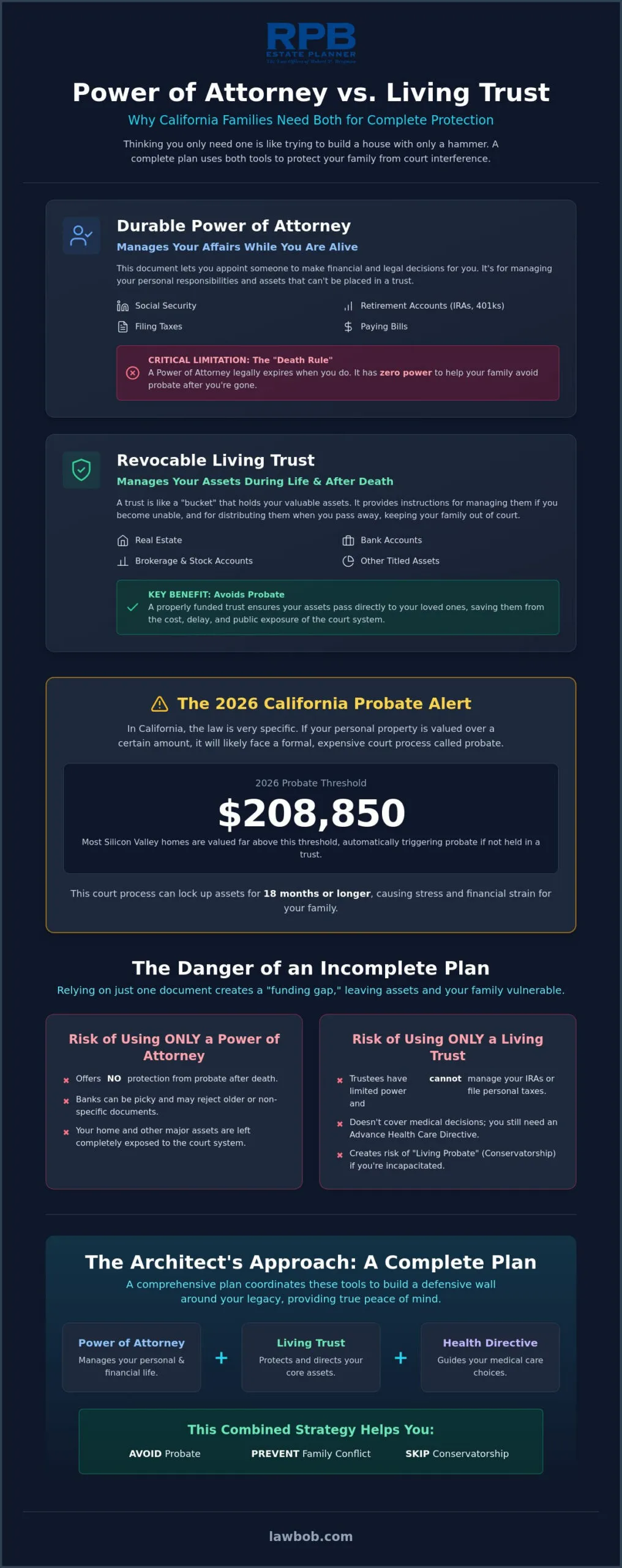
A Power of Attorney is a legal document that lets you name someone to make financial or legal decisions for you while you're still alive. A Revocable Living Trust is more like a "bucket" that holds your assets. It dictates how those assets are managed while you're here and how they're distributed after you pass away. There's a critical "Death Rule" you must understand: a Power of Attorney legally "dies" when you do. It has zero power to help your family avoid probate after you're gone.
For San Jose homeowners, this distinction is vital. Right now, high property values mean almost every single-family home in Silicon Valley will trigger a formal probate process. With the 2026 California probate threshold for personal property set at $208,850, a simple house easily pushes an estate into the court's hands unless a trust is in place to catch it.
What a Durable Power of Attorney Handles
This document manages the assets that usually can't be put into a trust. This includes your Social Security benefits, retirement accounts like IRAs or 401ks, and insurance policies. It also handles your day-to-day life. Your chosen agent can file your taxes, sign contracts, and ensure your bills are paid on time. I focus on "Durable" status to ensure this authority remains active if you ever become incapacitated and can't speak for yourself.
What a Revocable Living Trust Handles
A trust is designed to manage titled assets. This includes your real estate, bank accounts, and brokerage accounts. It acts as your architectural blueprint for inheritance. If you become unable to manage your affairs, a Successor Trustee steps in. They take over management of the trust assets immediately without needing to ask a judge for permission. This keeps your family out of the public court system and ensures a smooth transition of your legacy.
Why One Tool Is Rarely Enough for California Families
Relying on just one legal document creates what I call the "Funding Gap." A trust is a powerful tool, but it only controls the assets you've actually titled in its name. For everything else, you need a financial power of attorney. In 2026, California probate rules state that personal property valued over $208,850 will likely face formal probate court. If your Silicon Valley home or high-value accounts aren't properly moved into your trust, your family could be stuck in court for 18 months or longer.
Sometimes, families in San Jose discover a house was left out of the trust after a loved one passes away. In these cases, I often use a Heggstad Petition to ask the court to recognize the asset as part of the trust anyway. While this can save an estate from full probate, it's much better to avoid the stress by having your documents work in tandem from the start. This coordination also prevents "Living Probate." This is the legal term for a court-supervised Conservatorship that happens if you become incapacitated without the right paperwork in place.
The Problem with Using Only a Power of Attorney
A POA is strictly a lifetime tool. It offers zero protection or instructions for your children or spouse once you're gone. Even while you're alive, banks can be notoriously picky. They often reject older documents or those that lack specific California "magic words" required for certain financial transactions. Without a trust to hold your property, even a robust POA can't stop your estate from entering probate court through a "Pour-Over Will" after your death.
The Problem with Using Only a Living Trust
When looking at the power of attorney vs living trust debate, it's important to remember that Trustees have limited reach. They can't sign your personal income tax returns or manage your IRA accounts. You need a POA for those specific tasks. Additionally, a trust doesn't cover medical choices. You'll need an Advance Health Care Directive to ensure your doctors know your wishes. My "Architect" approach ensures these tools fit together perfectly. If you want to see how these pieces align for your specific situation, you can explore my custom estate planning services to ensure your legacy is fully protected.
Building Your Plan: Steps for San Jose Residents
Creating a plan that actually works requires more than just signing a few papers. In a high-stakes environment like Silicon Valley, your strategy must account for complex assets and specific state laws. When weighing a power of attorney vs living trust, the goal is to create a seamless handoff between these two tools so your family never has to step foot in a courtroom.
Follow these four essential steps to secure your legacy:
- Inventory your assets: List everything you own. In San Jose, this often includes high-value real estate and tech company stock options or RSUs. These require specific handling to avoid tax traps.
- Choose your team: You'll need to name an Agent for your Power of Attorney and a Successor Trustee for your trust. While these are often the same person, they serve different roles. One manages your personal finances while the other manages the trust assets.
- Consult a Certified Specialist: Work with a professional who understands the nuances of California law. A custom plan built by an expert ensures your documents won't be rejected by banks or the court.
- Fund your trust: This is the most vital step. You must retitle your home and accounts into the name of the trust. A trust that isn't funded is just a pile of expensive paper.
The "Architect" Approach to Estate Planning
I believe in building plans, not just drafting documents. Many "Trust Mills" or DIY online forms use a one-size-fits-all contractor approach. These often fail during a crisis because they don't account for the unique needs of blended families or heirs with special needs in the San Francisco Bay Area. A plan designed by a State Bar Certified Specialist acts as a custom architectural blueprint. It provides the precision and reliability you need to protect your family from unnecessary conflict.
Next Steps for Your Family
Planning for the future is an act of love for those you leave behind. Don't wait for a medical crisis to start this process. Incapacity planning is just as important as planning for what happens after death. It's the only way to avoid a costly, public conservatorship. If you're ready to move from uncertainty to total confidence, now is the time to act. Protect your family with a custom-designed estate plan from Robert P. Bergman.
Take Control of Your Family's Future Today
Your estate plan should be more than just a stack of papers; it's a defensive shield for your family's peace of mind. By now, you understand that the power of attorney vs living trust debate is really about building a complete system. One manages your personal affairs during your life, while the other protects your hard-earned assets from the delays of California probate. Coordinating these tools is the only way to avoid court interference and ensure your spouse and children are protected.
Robert P. Bergman is a Certified Specialist in Estate Planning, Trust & Probate Law who has served San Jose and the entire San Francisco Bay Area since 1980. Practicing California law since 1980, he uses a methodical "Architect" approach to build plans that stand the test of time. Don't leave your legacy to chance or outdated forms. You can Schedule Your Consultation with San Jose Estate Specialist Robert P. Bergman to start building a plan that truly fits your life. Taking this step now replaces uncertainty with a clear, reliable path forward for everyone you love.
Frequently Asked Questions
Does a Power of Attorney override a Living Trust in California?
No, a Power of Attorney does not override a Living Trust. These two documents are designed to work in parallel rather than competing for control. Your agent under a Power of Attorney manages assets held in your individual name, such as retirement accounts or Social Security benefits. Meanwhile, your Successor Trustee manages only the assets titled to the trust, like your family home. They cover different territories to ensure no part of your life is left unprotected.
What happens if I have a Living Trust but no Power of Attorney?
If you have a trust but no Power of Attorney, you leave a significant gap in your protection. A trust only controls the specific assets you've retitled into it. Without a POA, no one has the legal authority to sign your tax returns, manage your IRA, or handle insurance claims if you become incapacitated. This oversight often forces your family into a public, court-supervised conservatorship just to manage the daily financial tasks that a trust cannot touch.
Can my Power of Attorney move my house into my trust if I get sick?
Your agent can only move your house into your trust if your document specifically grants them the authority to transfer assets or "fund" the trust. This is a critical detail in the power of attorney vs living trust planning process. Many standard or DIY forms miss these specific California authorizations. If that language is missing and you can't sign the deed yourself, your family may be forced to file a Heggstad Petition in court later to fix the mistake.
Is a Power of Attorney cheaper than a Living Trust in San Jose?
A standalone Power of Attorney is generally less expensive to create than a complete Living Trust package, but it is a false economy. While a POA is an affordable way to handle life's daily tasks, it legally expires the moment you pass away. It cannot transfer your real estate or keep your estate out of the San Jose probate courts. Choosing only the cheaper document now often results in your family paying much higher court costs and statutory fees down the road.